
Tagging Select
The Tagging Select controller allows users to enter multiple values as tags into a text field with a menu of options.
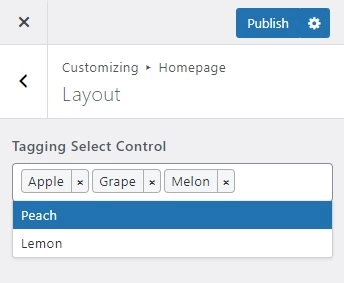
Demonstration
Handy::control( 'tagging-select', [
    'id'          => 'tagging_select_id',
    'section'     => 'layout_section',
    'label'       => esc_html__( 'Tagging Select Control', 'textdomain' ),
    'description' => esc_html__( 'Description Here', 'textdomain' ),
    'priority'    => 1,
    'choices'     => [
        'apple' => esc_html__( 'Apple', 'textdomain' ),
        'grape' => esc_html__( 'Grape', 'textdomain' ),
        'melon' => esc_html__( 'Melon', 'textdomain' ),
        'peach' => esc_html__( 'Peach', 'textdomain' ),
        'lemon' => esc_html__( 'Lemon', 'textdomain' )
    ]
]);
TIP
Here's an example using the default parameter. Note the default values must exist in defined choices.
Handy::control( 'tagging-select', [
    'id'          => 'tagging_select_id',
    'section'     => 'layout_section',
    'default'     => [ 'apple', 'grape', 'melon' ],
    'label'       => esc_html__( 'Tagging Select Control', 'textdomain' ),
    'description' => esc_html__( 'Description Here', 'textdomain' ),
    'priority'    => 1,
    'choices'     => [
        'apple' => esc_html__( 'Apple', 'textdomain' ),
        'grape' => esc_html__( 'Grape', 'textdomain' ),
        'melon' => esc_html__( 'Melon', 'textdomain' ),
        'peach' => esc_html__( 'Peach', 'textdomain' ),
        'lemon' => esc_html__( 'Lemon', 'textdomain' )
    ]
]);
TIP
Here's an example using the maximum parameter. Note the maximum value accepts only an integer data type.
Handy::control( 'tagging-select', [
    'id'          => 'tagging_select_id',
    'section'     => 'layout_section',
    'default'     => [ 'apple', 'grape', 'melon' ],
    'label'       => esc_html__( 'Tagging Select Control', 'textdomain' ),
    'description' => esc_html__( 'Description Here', 'textdomain' ),
    'priority'    => 1,
    'maximum'     => 5,
    'choices'     => [
        'apple' => esc_html__( 'Apple', 'textdomain' ),
        'grape' => esc_html__( 'Grape', 'textdomain' ),
        'melon' => esc_html__( 'Melon', 'textdomain' ),
        'peach' => esc_html__( 'Peach', 'textdomain' ),
        'lemon' => esc_html__( 'Lemon', 'textdomain' )
    ]
]);
Basic Usage
// Return an array.
$values = get_theme_mod( 'tagging_select_id' );
Parameters
| Name | Description |
|---|---|
| id |
The unique slug like string used as an ID and also as an index name in storing data in a database. |
| section |
The ID of the section in which the control will be displayed. |
| default |
The predetermined value of the control. Accepts values only from defined |
| choices |
The array-based list of predetermined options or choices. |
| maximum |
The tagging's total maximum or limit values. Default |
| label |
The label or title of the control to show in the UI. Default empty. |
| description |
The description of the control to show in the UI. Default empty. |
| placeholder |
The placeholder of the control to show in the UI. Default empty. |
| priority |
The order of control appears in the section. Default |
| validations |
The set of validations used to validate the value of the control. For further details, read validations. Default empty. |
| active_callback |
A callback function that determines the visibility of a control, whether to show or hide depending on a condition. For further details, read active_callback. Default empty. |
| sanitize_callback |
A callback function that sanitizes the value of control before storing it in the database. Note that this is only optional since each control is already well sanitized. For further details, read sanitize_callback. Default empty. |